
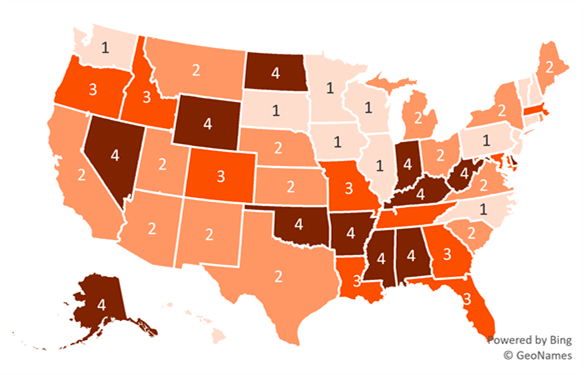

Average divorce costs by state
Filing fees and attorney rates vary significantly depending on where you live. While national averages provide a baseline, your actual expenses will depend on your state’s court system and local legal market rates. Understanding these regional differences helps you budget accurately before filing.
The table below compares typical costs across five key states. These figures reflect average filing fees, hourly attorney rates, and estimated total costs for both uncontested and contested divorces.
| State | Filing Fee | Avg. Hourly Rate | Uncontested Total | Contested Total |
|---|---|---|---|---|
| California | $435 | $350–$500 | $2,500–$5,000 | $15,000–$30,000+ |
| New York | $210–$335 | $300–$600 | $1,500–$3,000 | $10,000–$25,000+ |
| Texas | $250–$300 | $250–$450 | $1,500–$3,000 | $10,000–$20,000+ |
| Florida | $408 | $250–$400 | $1,500–$2,500 | $8,000–$15,000+ |
| Illinois | $304–$400 | $300–$500 | $2,000–$4,000 | $11,000–$20,000+ |
Filing fees are generally non-refundable and paid to the county clerk when you submit your petition. Attorney hourly rates reflect the going market rate for family law specialists in each state. Total costs for uncontested divorces assume both parties agree on all terms, while contested totals reflect cases that require litigation or extensive negotiation.
Use this calculator to get a rough estimate based on your state’s typical filing fee and attorney rates. Multiply the hourly rate by the estimated hours your case will require, then add the filing fee. This provides a baseline for budgeting, though actual costs may vary based on case complexity and local court procedures.
Uncontested vs. contested divorce fees
The difference in cost between an uncontested and a contested divorce is rarely a matter of hundreds of dollars; it is usually a matter of tens of thousands. The primary driver of this disparity is not the filing fee, but the billable hours required to navigate legal conflict. When spouses agree on terms, the process is administrative. When they disagree, it becomes a legal battle.
An uncontested divorce occurs when both parties agree on all major issues, including asset division, child custody, and support. Because there is no litigation, legal fees are typically limited to document preparation and filing. In many states, this can be completed for a few hundred to a few thousand dollars, particularly if using online services or limited-scope legal assistance.
A contested divorce arises when spouses cannot agree on one or more critical issues. This triggers formal discovery processes, including interrogatories, depositions, and financial disclosures. Each step requires attorney hours, court appearances, and potentially expert witnesses. Legal fees can quickly escalate from a few thousand to over $100,000, depending on the complexity of assets and the duration of the dispute.
The following calculator estimates the potential cost difference based on average hourly rates and estimated hours for each path. Note that these are estimates; actual costs vary significantly by jurisdiction and case complexity.
Hidden Costs Beyond Attorney Fees
Attorney retainers and hourly rates often represent only a portion of the total financial burden. The actual cost of divorce is frequently inflated by mandatory third-party services and administrative fees that are not included in legal billing. Understanding these ancillary expenses is essential for accurate budgeting.
Mediation and Financial Experts
Mediation is a common alternative to litigation, but it is rarely free. While generally cheaper than court battles, mediation fees typically range from $100 to $300 per hour per party. If the divorce involves complex assets like businesses or retirement accounts, courts may require a forensic accountant or valuation expert. These specialists often charge $250 to $500 per hour, adding thousands to the final bill if disputes over asset division arise.
Service of Process and Filing Fees
Every state requires an initial filing fee to open a case, which varies significantly by jurisdiction. These fees typically range from $150 to $500. Additionally, the legal process requires formal notification of the other party. If the spouse cannot be served voluntarily, a professional process server or sheriff’s deputy must be hired. This service of process fee usually costs between $50 and $150 per attempt, and multiple attempts may be necessary if the respondent is difficult to locate.
Estimated Hidden Costs Calculator
Use the calculator below to estimate the potential impact of these hidden fees on your total divorce costs. Input your estimated hourly rates and expected usage of third-party services.
Divorce costs for non-working spouses
When one spouse has little or no income, the immediate barrier to filing for divorce is often court filing fees and attorney retainers. These costs typically range from $200 to over $1,000 depending on the state, plus hourly legal fees that can quickly accumulate. Without personal assets or income, navigating these expenses requires specific legal strategies and financial assistance programs.
Courts recognize that lack of income should not prevent access to justice. In many jurisdictions, a non-working spouse can file an in forma pauperis (IFP) motion to waive or reduce court filing fees. This process requires submitting financial affidavits detailing income, assets, and expenses. If approved, the court may waive the initial filing fee entirely or allow it to be paid in installments.
Attorney fees present a more complex challenge. While some lawyers offer reduced rates or payment plans, many require upfront retainers. However, in high-stakes cases involving domestic violence or significant asset disparity, courts may order the higher-earning spouse to pay temporary legal fees for the non-working spouse. This "fee shifting" ensures both parties have equal representation during the proceedings.
For those who do not qualify for fee waivers, legal aid organizations and pro bono services provide critical support. Many state bar associations maintain directories of free legal services for low-income individuals. Additionally, some law schools offer clinics where supervised law students handle divorce cases at no cost.
To estimate your potential costs, use the calculator below. It accounts for filing fees, attorney hourly rates, and estimated hours of legal work. Note that this is an estimate; actual costs vary by jurisdiction and case complexity.
Calculate your estimated divorce cost
Your final bill depends on three main variables: court filing fees, your attorney’s hourly rate, and the number of hours spent on your case. Filing fees are fixed by state law, while legal fees fluctuate based on complexity and location. Use the tool below to model your potential expenses.
This calculator provides a baseline estimate. It includes the initial court filing fee and the projected legal fees based on your inputs. It does not account for additional costs such as mediator fees, private investigators, or expert witness testimony, which can significantly increase the total in contested cases. For a more precise figure, consult a local attorney to discuss your specific situation.
Manage legal fees with a clear plan
Controlling divorce costs requires proactive management of both your legal team and your documentation. Attorney fees typically range from $100 per hour for new lawyers to over $300 per hour for experienced practitioners, making efficiency the primary lever for reducing your total bill. By organizing financial records before the first consultation, you minimize the billable hours spent on discovery and administrative tasks.
Choose the right fee structure
Legal billing generally falls into two categories: hourly rates and flat fees. Hourly billing is standard for contested divorces where the scope of work is unpredictable. Flat fees are often available for uncontested divorces or specific services like document preparation. Understanding which structure applies to your case helps you predict maximum costs and avoid surprise invoices. For state-specific filing fees and basic cost estimates, refer to official state court websites or established legal directories like FindLaw.
Organize documents early
Disorganized files are a major driver of legal expenses. Attorneys spend significant time locating bank statements, tax returns, and property deeds. Create a single, labeled digital folder for all financial records, correspondence, and asset documentation before hiring counsel. This preparation allows your lawyer to focus on strategy rather than administration, directly lowering the hours billed to your account.
Consider mediation
Mediation is a cost-effective alternative to traditional litigation. In this process, a neutral third party helps you and your spouse reach agreements on asset division and custody without going to court. Mediation fees are typically shared and are significantly lower than the cumulative cost of two attorneys negotiating through depositions and hearings. This approach is best suited for couples who can communicate directly and are willing to compromise.
Frequently asked questions about divorce costs
Understanding the financial mechanics of a divorce helps prevent unexpected surprises during a stressful process. Below are answers to common questions regarding filing fees, attorney payment structures, and the cost implications of mediation.
No comments yet. Be the first to share your thoughts!