

The expanding digital footprint
I spoke with an attorney recently about a divorce where an Instagram photo of a spouse on a luxury vacation changed everything. The image directly contradicted their claims of financial hardship. This happens all the time now. Divorce is fought online, and a single post can have permanent legal consequences.
We’re seeing a dramatic shift in how divorce cases are litigated. Where once the focus was primarily on physical assets and documented income, now a significant portion of discovery revolves around digital data. This includes everything from social media posts and emails to cryptocurrency transactions and data gleaned from smart home devices.
Digital forensics is moving fast. It used to be enough to print a few Facebook posts, but now we deal with data recovery and metadata analysis. By 2026, the tools will be even more advanced. Ignoring this is a mistake that usually ends up costing a lot of money.
Digital evidence isn’t just about proving infidelity, though that’s still a common application. It’s about establishing a comprehensive picture of a spouse’s lifestyle, financial situation, and overall behavior. It’s about uncovering hidden assets and challenging false narratives.
Social media is more than just posts
Social media is often the first place attorneys look in a divorce case, and for good reason. Platforms like Facebook, Instagram, TikTok, and even dating apps are goldmines of potentially damaging information. A seemingly innocent post bragging about a new purchase can undermine claims of poverty. Photos showing a different lifestyle than the one presented in court can raise serious questions.
It’s not just the content of posts that matters, but also the metadata associated with them. Location data can reveal where a person was at a specific time, potentially disproving an alibi. Timestamps can establish a timeline of events. Even deleted content isn’t necessarily gone – specialized software can often recover it.
The Pensacola Law Office notes that in Florida custody cases, social media posts are frequently used to assess a parent's character and lifestyle. Screenshots of inappropriate content, evidence of substance abuse, or displays of poor judgment can all be detrimental to a custody claim. This principle applies broadly, not just in Florida.
Don't assume privacy settings offer complete protection. While they can limit visibility, they don’t necessarily prevent evidence from being obtained through legal means like subpoenas or forensic analysis. Furthermore, friends and family members can easily screenshot and share content, regardless of privacy settings.
- Facebook timeline posts, photos, and private messages often show a different reality than court filings.
- Instagram: Photos, videos, stories, direct messages, tagged locations.
- TikTok: Videos, comments, likes, duets, direct messages.
- Dating Apps (Tinder, Bumble, etc.): Profiles, messages, photos – often revealing infidelity or intentions.
The hidden half of crypto assets
Cryptocurrency is a growing challenge in divorce proceedings. It’s easily hidden, difficult to trace, and often volatile in value. Many people underestimate the extent of their spouse’s crypto holdings, or are simply unaware they exist.
The decentralized nature of blockchain technology makes tracking transactions complex. While transactions are public, identifying the owner of a crypto wallet can be difficult, especially if the spouse has taken steps to conceal their identity. They might use multiple wallets, mixers, or offshore exchanges.
Forensic accountants specializing in cryptocurrency are becoming increasingly valuable. They have the tools and expertise to trace transactions, identify hidden wallets, and determine the true value of crypto assets. Expect to pay several thousand dollars for a thorough investigation. It’s an investment that can easily pay for itself if significant assets are uncovered.
Stablecoins and Non-Fungible Tokens (NFTs) are also increasingly relevant. Stablecoins, pegged to a fiat currency like the US dollar, are considered marital property just like cash. NFTs, representing ownership of digital assets, can also have significant value and are subject to division in a divorce.
How AI changes discovery
Artificial Intelligence is starting to play a role in divorce discovery, and its influence will only grow by 2026. AI-powered tools are being used for e-discovery – sifting through massive amounts of data to identify relevant documents and communications. This can save time and money compared to manual review.
Sentiment analysis, another application of AI, can analyze emails and messages to identify emotional tone and hidden meanings. This can be useful in cases involving allegations of abuse or infidelity. AI can also be used to identify patterns of communication that might indicate hidden assets or illicit activities.
AI has its own problems, specifically bias. Algorithms are only as good as their training data, and bad data leads to wrong results. An attorney still needs to oversee and interpret whatever the software spits out.
This isn’t about robots making decisions in your divorce. It’s about AI assisting lawyers in their investigations. But it also means your spouse’s attorney might be using AI against you, so you need to be prepared.
AI Tools for Divorce Discovery
| Tool Category | Example Tools | Pros | Cons | Cost (approximate range) |
|---|---|---|---|---|
| e-Discovery | Relativity, Disco, Everlaw | Comprehensive document review, robust search capabilities, strong security features. | Can be complex to learn and implement, potentially high costs for large datasets. | Higher |
| Social Media Analysis | Social Sentinel, EyeWitness, LocateAI | Gathers publicly available social media data, identifies potential inconsistencies in testimony, reveals hidden assets or activities. | Privacy concerns, data accuracy can be questionable, requires careful interpretation. | Moderate |
| Asset Tracing | Guidance Software EnCase, Cellebrite, Magnet AXIOM | Identifies and tracks financial assets, uncovers hidden accounts, assists in forensic accounting. | Requires specialized expertise, can be time-consuming, legal admissibility of findings can be challenged. | Higher |
| Sentiment Analysis | Lexalytics, MonkeyLearn, MeaningCloud | Analyzes text (emails, messages) to determine emotional tone, identifies potential bias or deception, can reveal marital discord. | Subjective interpretation, accuracy depends on data quality, may not capture nuanced meaning. | Moderate |
| Data Extraction & Conversion | FTK Imager, X-Ways Forensics, AccessData | Extracts data from various devices and formats, converts data for analysis, creates forensic images. | Requires technical expertise, can be time intensive, potential for data corruption if not handled correctly. | Moderate |
| AI-Powered Document Summarization | ROSS Intelligence (now part of Casetext), Kira Systems, LawGeex | Quickly summarizes lengthy documents, identifies key clauses and information, reduces review time. | May miss subtle nuances, accuracy depends on document complexity, requires human review. | Moderate to Higher |
Qualitative comparison based on the article research brief. Confirm current product details in the official docs before making implementation choices.
Email and messaging
Don’t underestimate the power of seemingly innocuous emails and text messages. Beyond the content of the messages themselves, the metadata – the data about the message – can be incredibly revealing. This includes timestamps, sender and receiver information, and even location data.
Deleted emails and messages aren’t always gone forever. Data recovery software can often retrieve them, even after they’ve been purged from the trash. It's important to understand that deleting something digitally doesn't always mean it's permanently removed.
The use of encryption and self-destructing messages is becoming more common, but it’s not a foolproof solution. While encryption can protect the content of messages, it doesn’t necessarily hide the fact that communication occurred. And self-destructing messages can often be recovered with the right tools.
AI can now analyze communication patterns to identify potential infidelity or financial misconduct. For example, an AI algorithm might flag a sudden increase in late-night communications with an unknown number.
Smart home devices
Smart home devices – smart speakers, security cameras, smart TVs – are collecting vast amounts of data about your daily life. This data can be subpoenaed and used as evidence in a divorce case. What you say to your smart speaker, the footage captured by your security cameras, and your viewing habits on your smart TV can all be relevant.
Voice recordings are particularly sensitive. What you say in the privacy of your own home could be used against you in court. Activity logs can reveal your routines and habits. Purchase histories can provide insights into your spending patterns.
During divorce proceedings, consider temporarily disconnecting or securing your smart home devices. Change passwords, disable voice recording features, and review privacy settings. It’s a proactive step to protect your privacy and control the information that’s available to your spouse.
Be aware that many smart home devices store data in the cloud, which means it’s not necessarily protected by your local network security.
How to preserve digital evidence
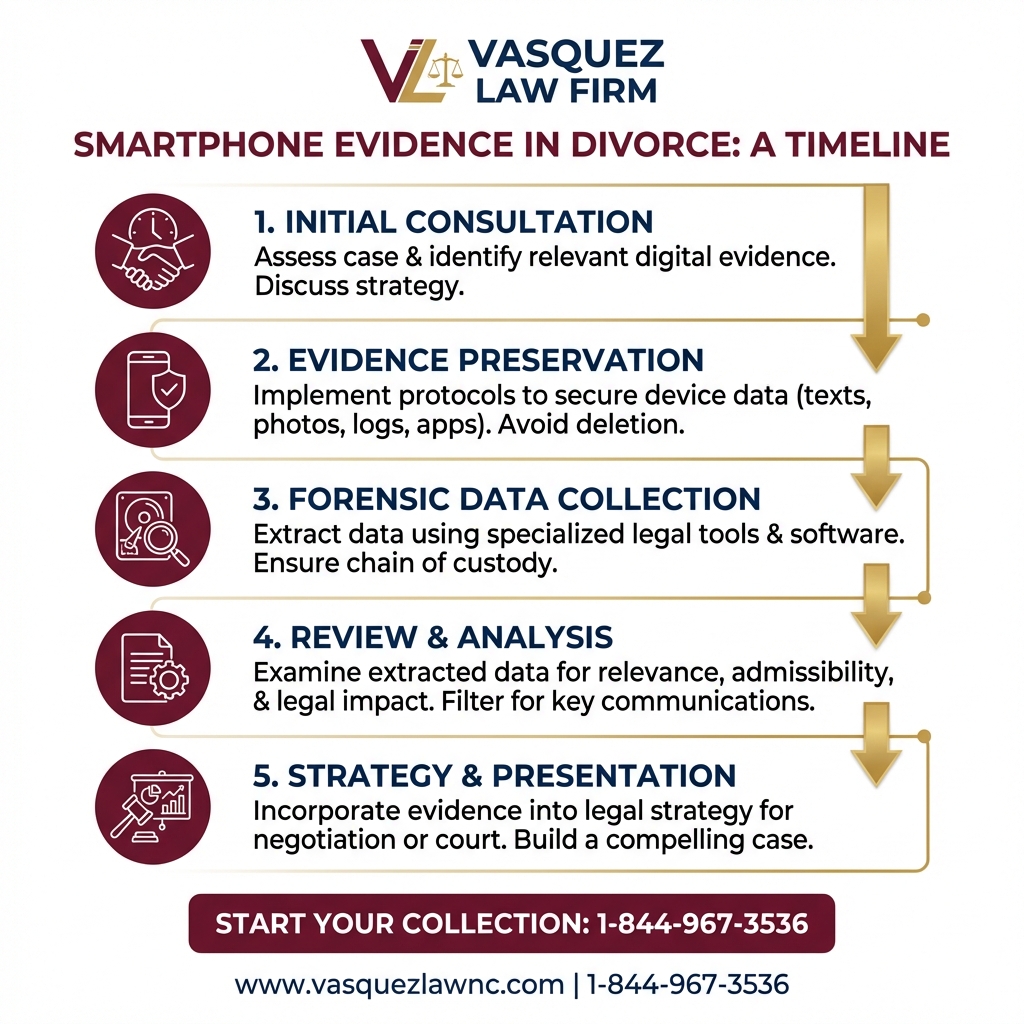
Preserving digital evidence is crucial, but it needs to be done correctly to ensure it’s admissible in court. Start by creating forensic images of devices – essentially, a bit-for-bit copy of the data. This preserves the original data and prevents tampering.
Secure social media accounts by changing passwords and enabling two-factor authentication. Document all relevant posts, photos, and messages by taking screenshots or downloading the data. Don’t rely on simply remembering what was posted – document it.
Document all financial transactions, including bank statements, credit card statements, and cryptocurrency transactions. Back up all electronic data to a secure location, such as an external hard drive or a cloud storage service.
Maintaining a chain of custody is essential. This means documenting who had access to the evidence and when. Any break in the chain of custody could jeopardize the admissibility of the evidence. Disclaimer: I am not an attorney, and this is not legal advice. Consult with a qualified attorney to discuss your specific situation. Experts in Family Law emphasize the increasing importance of proactively gathering and preserving digital evidence.
- Talk to an attorney first to ensure your collection methods are legal.
- Step 2: Create forensic images of relevant devices.
- Step 3: Secure social media accounts and document content.
- Step 4: Document financial transactions.
- Step 5: Back up all electronic data.
- Step 6: Maintain a clear chain of custody.



No comments yet. Be the first to share your thoughts!